
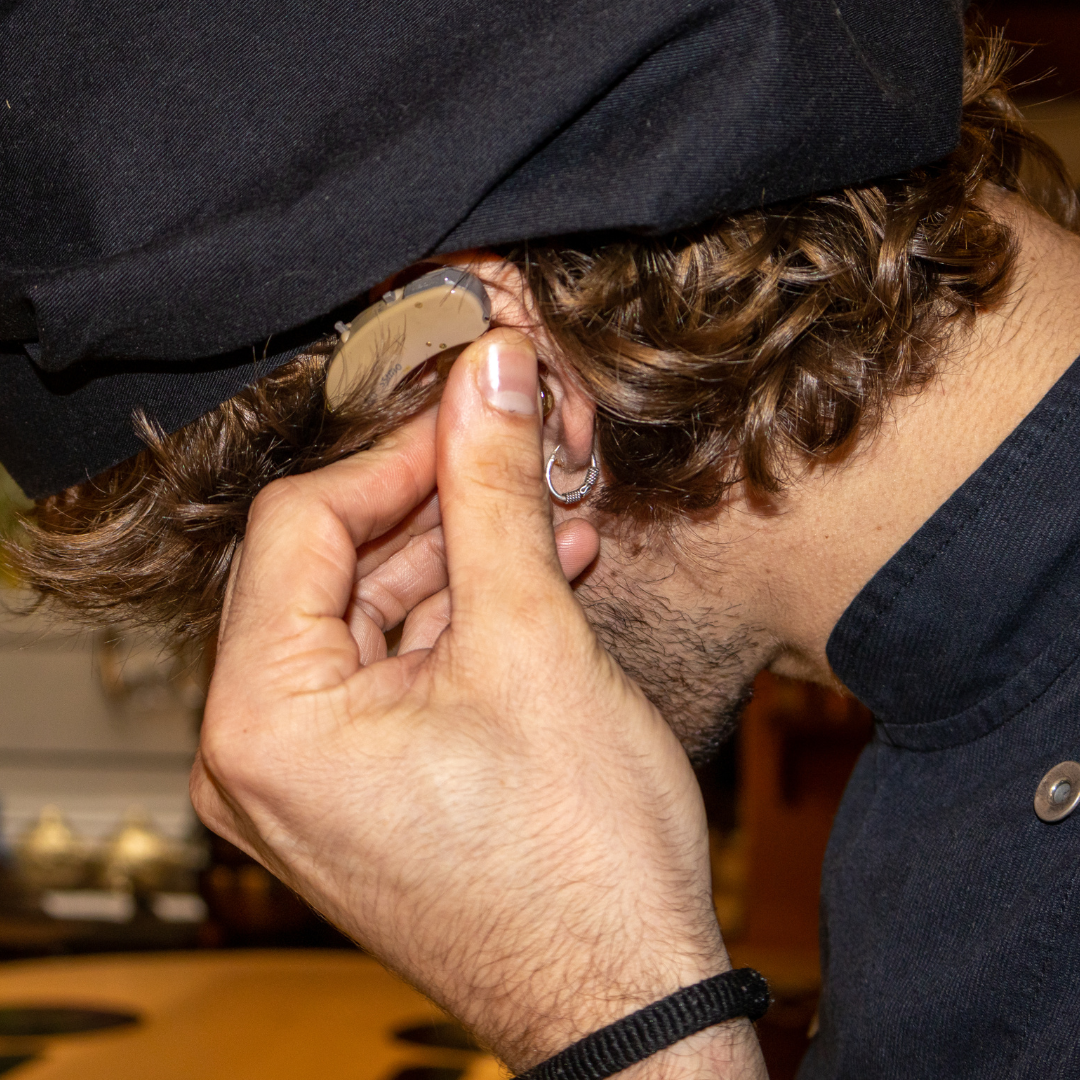
Restaurant conversations can be difficult to follow when environmental noise competes with your focus and hearing. Our audiology clinic conducts specialized testing to evaluate hearing in both quiet sound booths and noisy simulations to isolate the underlying cause. After diagnosing the source of your difficult hearing, we design targeted interventions tailored to your listening needs.
Why Everyday Hearing Fails in Busy, Noisy Restaurants
Low-noise environments yield an advantageous signal-to-noise ratio where primary speech remains significantly louder than background sound. Commercial restaurant spaces present the polar opposite acoustic dynamic. Multiple voices, music, kitchen noise, and reverberation overlap with speech, forcing the ears and brain to work harder to separate the person you want to hear.
This problem can occur with high-frequency hearing loss, auditory-processing difficulty, or age- and noise-related changes. Attention, fatigue, dim lighting, and distance from the speaker may make it worse. Numerous individuals show standard hearing thresholds on paper but reveal marked comprehension drops on clinical speech-in-noise testing. Experiencing speech-recognition struggles in noisy dining venues warrants a formal audiological evaluation regardless of seemingly normal quiet hearing.
How Audiologists Identify High-Frequency Hearing Loss
Diagnostic assessment begins by documenting specific listening breakdowns, recreational noise exposure, tinnitus symptoms, medications, and hereditary auditory patterns.
Through pure-tone audiometry, we determine your faintest auditory perception across low to high pitches utilizing both air and bone conduction testing. A clinical presentation of high-frequency loss produces a downward-sloping audiogram where auditory thresholds worsen significantly at higher frequencies. Supplementary assessments routinely include diagnostic tympanometry to analyze middle-ear status alongside word-recognition testing to determine speech clarity.
Standard quiet test booths fail to simulate real-world restaurant noise, making speech-in-noise testing a crucial clinical tool. The test assesses word and sentence discrimination as background acoustic competition intensifies. Interpreted together, these clinical scores demonstrate whether listening struggles originate from loss of audibility, speech clarity deficits, auditory processing delays, or combined elements.
How Do Auditory Processing Disorders Affect Hearing in Adults?
A central auditory processing disorder disrupts the neurological transmission and cognitive interpretation of sound waves. The ears may detect tones at expected levels, but the brain may have difficulty organizing competing signals, distinguishing similar speech sounds, or following rapid conversation. We prioritize assessing peripheral auditory acuity before recommending an in-depth central auditory-processing assessment or external medical referrals.
Actionable Listening Tips for Noisy Social Settings
Small, intentional adaptations can optimize the clarity of speech reaching your ears and leverage helpful visual speech cues. When planning to dine out, select restaurants with calmer atmospheres or arrange reservations during off-peak hours. Dining locations utilizing sound-absorbing elements like booths, felt panels, window curtains, and carpet offer better acoustics than high-ceilinged rooms with hard surfaces.
Practical seating strategies in the dining room:
- Select a secluded table situated away from prep kitchens, crowded bar stations, loudspeaker zones, and large parties.
- Position yourself with your back toward a solid partition to dampen intrusive background noise from behind.
- Ensure you sit directly across from speaking partners in an area with sufficient illumination for visual lip-reading.
- Keep the distance between speakers as short as comfortably possible.
- Turn your better-hearing ear toward the specific speaker you want to hear most clearly.
- Encourage speakers to rephrase key information rather than simply repeating unparsed words louder.
- Validate significant pieces of information directly rather than feigning understanding during dialogue.
- Step into a quiet area for a few minutes when listening fatigue begins to compromise focus.
- Ask companions to speak clearly at a natural pace.
- Raised or shouting voices warp acoustic phonetics and rarely improve speech intelligibility.
Assistive Hearing Tools and Technology for Complex Acoustic Environments
Selecting the ideal assistive technology depends upon underlying diagnosis, specific acoustic challenges, and verified hearing loss. Customized hearing aids employ directional microphone beamforming, noise cancellation algorithms, and targeted dining programs to prioritize speakers in front while lowering ambient noise. Patients must uphold realistic expectations because modern amplification cannot strip out every ambient human voice completely.
Utilizing an external remote microphone can deliver a dramatically superior signal-to-noise ratio. The microphone is placed near or worn by the speaker and sends that voice directly to compatible hearing aids or another receiver. This strategy bypasses the detrimental effects of room reverberation, distance, and localized background chatter.
Other useful options include:
- Wireless conference table microphones that capture multi-speaker discussions
- Telecoil sensors configured to access hearing-loop broadcasts in looped facilities
- Real-time smartphone speech-to-text transcription and live-captioning apps
- Smart earbuds offering dedicated speech-in-noise amplification settings
- Decibel-monitoring apps and crowd-sourced dining platforms that track restaurant noise
Our team can compare these systems, verify device compatibility with your hearing aids, and provide comprehensive training on their use.
How Can a Doctor Help with Hearing in Loud Places?
Clinical hearing evaluations progress the diagnostic process past the typical assertion that hearing is adequate in quiet. We analyze the exact social venues, voice registers, and noise environments that cause difficulty to administer tests matching your lifestyle. The assessment may include pure-tone thresholds, middle-ear testing, word recognition, and speech-in-noise measures. Specialized auditory-processing testing can be ordered when patient history and preliminary audiometric findings warrant deeper neural investigation.
Rapidly progressing, asymmetrical, or sudden hearing decline warrants an urgent clinical referral to an ear, nose, and throat physician. Personalized care identifies the source of the difficulty rather than assuming restaurant noise is the only problem.
Arrange a Hearing Evaluation With Us Now
When dining out causes you to guess at words, detach from family, or experience severe listening exhaustion, book a comprehensive hearing evaluation with us. We will help you navigate hearing in noisy environments by implementing advanced hearing aid options, assistive accessories, or therapeutic auditory strategies tailored to your lifestyle.
Reach out to our audiology clinic today to schedule an evaluation and begin enjoying clear, effortless conversations.