
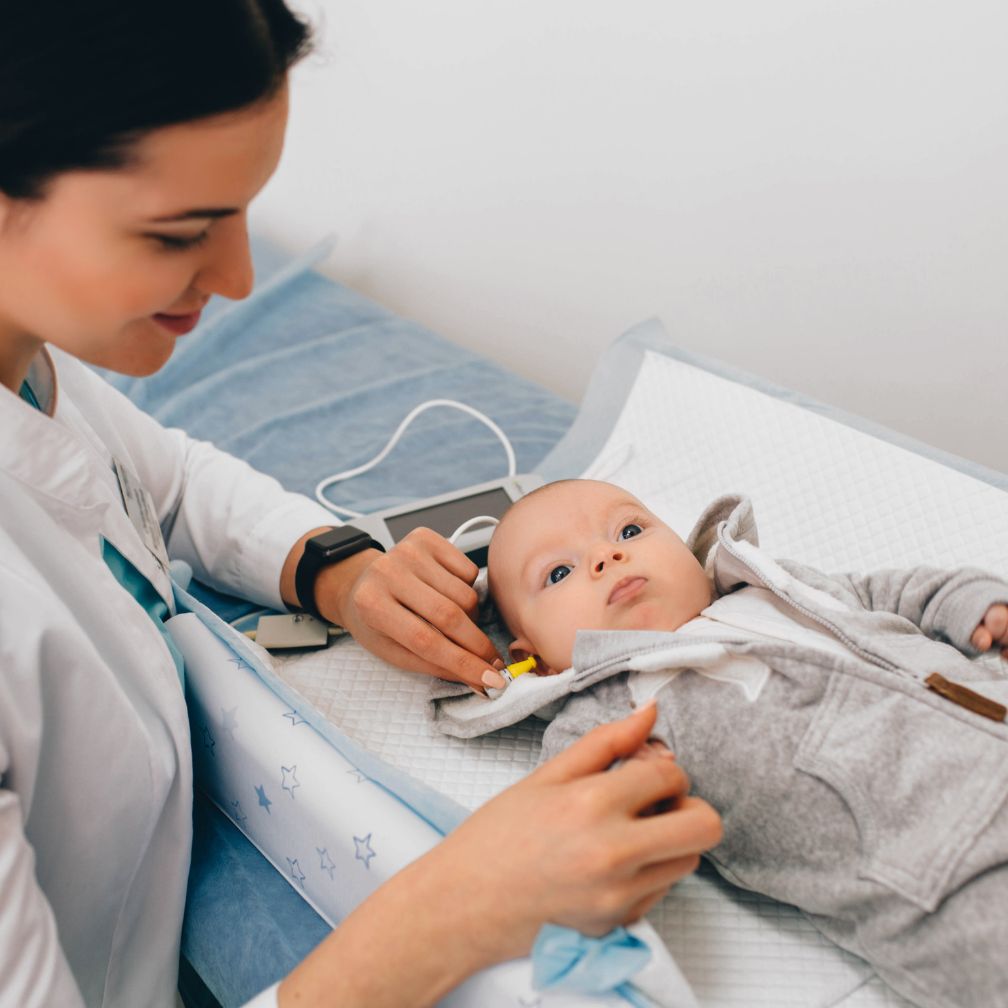
For newly expectant or practicing parents, learning that their baby has hearing loss often feels deeply disheartening and sad. Fortunately, the reassuring perspective dictates that through timely checks and early help, babies with hearing issues routinely attain profound developmental success. Clearly, such children consistently gain core language skills, social capabilities, and firm bonds with people in their lives, building toward a prosperous life!
Utilizing individual hearing aids alongside surgical cochlear implants provides two highly successful approaches for guiding infants with hearing loss. In the passage below, we evaluate their functional mechanisms and clarify how to select the perfect fit for your infant.
Demystifying Hearing Deficits in Newborns
Auditory loss among infants can result from various distinct health factors, such as:
- Specific hereditary genetic markers (even completely lacking any prior parental history)
- Prenatal viral exposures such as cytomegalovirus (CMV) or rubella pathogens
- Severe delivery difficulties, such as acute oxygen deprivation or premature delivery
- Specific therapeutic drugs administered within specialized newborn intensive units
What constitutes the single most vital measure? Timely diagnostic identification. This necessity explains why babies across the United States undergo auditory checks prior to leaving the birth facility. Experienced pediatric audiologists strictly uphold the universal “1-3-6” care benchmark:
- Primary screening executed within 30 days of birth
- Official diagnostic verdict secured prior to 3 months post-birth
- Early therapeutic care (utilizing personal devices or developmental therapy) started prior to 6 months of life
Achieving these critical milestones provides infants their ideal path toward speech, language, and cognitive development. If you need guidance on these screenings, your primary pediatrician stands ready to assist you!
Understanding Amplification Devices for Infants
For young children demonstrating mild to severe hearing challenges, custom hearing aids usually act as the primary solution. These miniature, wearable instruments elevate acoustic volume, enabling infants to perceive speech and ambient sounds with greater clarity.
Hearing aids are:
- Fully safe and suitable for babies only a few weeks old
- Manufactured with pliable, gentle custom molds that adapt as the baby matures
- Equipped with child-resistant battery compartments and custom pediatric safety options
- Professionally configured by a pediatric audiology specialist to accommodate your infant’s exact hearing needs
Throughout early childhood growth, hearing instruments necessitate frequent maintenance to guarantee ideal ear-canal fit and maximum performance.
Understanding Cochlear Implantation for Babies
When an infant presents with severe to profound sensorineural hearing deficits and fails to receive sufficient benefit from standard hearing aids, a cochlear implant might be advised. Unlike external acoustic hearing aids, cochlear implant devices:
- Require placement through a routine surgical procedure within the patient’s inner ear
- Safely bypass damaged hair cells inside the cochlea
- Convert sound waves into focused electrical signals that actuate the nerve of hearing
Dedicated pediatric cochlear devices serve as:
- Formally FDA-cleared for pediatric patients as young as 9-12 months
- Profoundly successful when paired with early auditory-verbal therapy and active household backing
- Advised exclusively after a comprehensive diagnostic assessment by a pediatric audiologist and ear, nose, and throat doctor
This evaluative framework encompasses radiological imaging, advanced hearing evaluations, and realistic discussions regarding long-term developmental milestones.
Comparing Hearing Aids and Cochlear Implants: Key Differences
- Mild to severe levels of impairment utilize Hearing Aids; Severe to profound levels of loss demand Cochlear Implants
- Non-Invasive external fitting: Hearing Aids; Surgical insertion required: Cochlear Implants
- Physical sound amplification: Hearing Aids; Electrical signal stimulation conversion: Cochlear Implants
- Fitting starts at early infancy: Hearing Aids; Access starts at 9-12 months: Cochlear Implants
Hearing Aids vs. Cochlear Implants: Final Thoughts
If your baby has been diagnosed with hearing loss, remember that proven treatment choices and plenty of support. Thanks to collaboration with dedicated pediatric audiologists, countless infants successfully cultivate communication skills that mirror those of their age group.
Whether your child is a candidate for hearing aids or cochlear implants, taking immediate action unlocks lifelong developmental success.
Have you got specific questions concerning your newborn’s hearing abilities? Contact our clinical team today to arrange a comprehensive evaluation and customized treatment program.